
Real-Time Decision-Making During Escalation Risk
Frontline workers often manage unpredictable situations where occupational violence and aggression risks can escalate rapidly.
The PACER Framework provides practical guidance to help workers recognise risks early, communicate effectively, disengage safely, and recover appropriately after incidents.
The focus is always on maintaining physical safety, psychological safety, and safe service delivery.
Practical Frontline OVA Risk Management
Many workplace violence training programs focus heavily on physical intervention or reactive de-escalation techniques.
PACER takes a broader approach by supporting:
- Situational awareness
- Dynamic risk assessment
- Structured communication
- Prevention-focused decision-making
- Safe disengagement
- Recovery and learning
This helps staff respond more consistently and confidently in high-pressure situations.
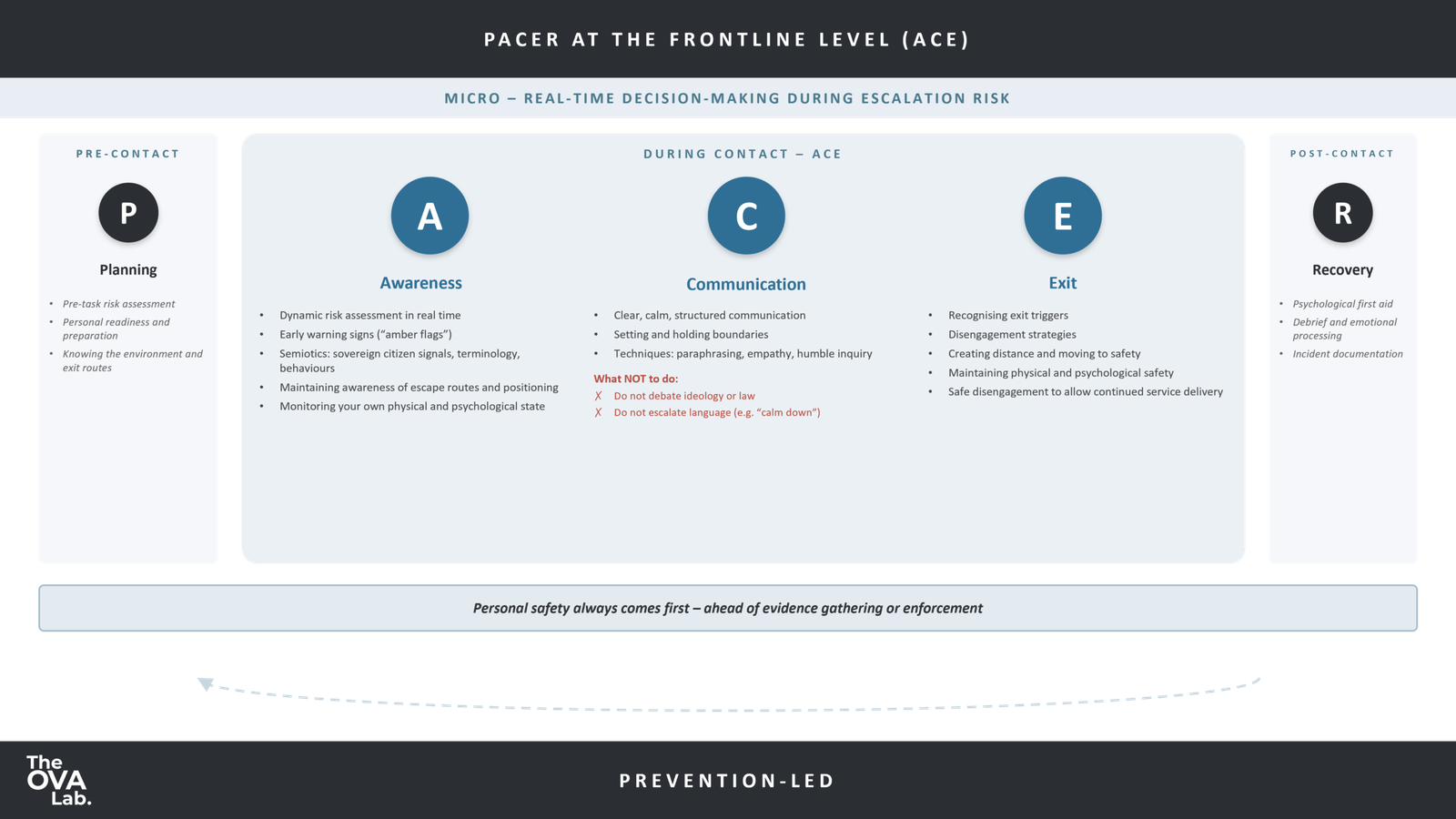
Planning
Preparing Before Contact Occurs
Planning at the frontline level focuses on personal and operational readiness.
This may include:
- Pre-task risk assessment
- Understanding the operational environment
- Identifying exits and safe positioning
- Reviewing known risks
- Preparing communication approaches
Preparation improves both safety and decision-making under pressure.
Awareness
Recognising Escalation Risks Early
Awareness is critical during public-facing interactions.
Participants learn to identify:
- Early warning signs of aggression
- Behavioural escalation indicators
- Environmental risks
- Positioning and escape route considerations
- Personal stress and cognitive overload indicators
The framework also supports awareness of behavioural patterns associated with higher-risk interactions, including sovereign citizen behaviours and escalation signals.
Communication
Calm, Structured, and Professional Communication
Communication strategies focus on reducing escalation while maintaining boundaries and professionalism.
This may include:
- Calm and structured communication
- Active listening
- Paraphrasing
- Empathy
- Humble inquiry
- Clear boundary setting
PACER also identifies communication approaches that may unintentionally escalate risk, such as debating ideology, arguing legal interpretations, or using emotionally charged language.
Exit
Safe Disengagement and Withdrawal
The PACER Framework reinforces that workers do not need to remain in unsafe situations.
Exit strategies may include:
- Recognising escalation triggers
- Creating physical distance
- Withdrawing safely
- Escalating concerns
- Repositioning to safer environments
The priority is always preserving physical and psychological safety.
Recovery
Supporting Wellbeing and Learning After Incidents
Recovery helps workers process incidents safely while contributing to organisational learning.
Recovery activities may include:
- Psychological first aid
- Debriefing
- Emotional processing
- Incident documentation
- Support pathways
These processes help strengthen resilience and future operational capability.
Safety Always Comes First
PACER reinforces a critical principle:
Personal safety always comes first, ahead of evidence gathering, enforcement outcomes, or completing operational tasks.
This prevention-led approach helps organisations create safer workplaces and more sustainable operational practices.
Enquire About Frontline PACER Training
Contact The OVA Lab to discuss frontline occupational violence and aggression capability development tailored to your workforce.