
Prevent OVA.
Protect your people.
Protect your leadership.
Strengthening occupational violence prevention for councils, regulators, and public‑facing government authorities.
We work with councils, regulators, and public-facing government environments to strengthen occupational violence prevention through systems-based risk management, leadership capability, and organisational resilience.
Occupational Violence Rarely Starts with Violence
WHY MOST OVA APPROACHES FAIL
Occupational violence and aggression often represent the most visible and severe manifestations of broader behavioural and psychosocial risk.
Escalation frequently begins much earlier through workplace conflict, communication breakdowns, harmful workplace behaviours, customer frustration, and organisational pressures.
Effective prevention requires organisations to build capability across the entire escalation pathway, from workplace conflict and behavioural risk through to aggression and critical incidents.
Many traditional OVA approaches focus heavily on frontline behaviour while overlooking the organisational systems, operational conditions, and governance factors that shape escalation risk.
Frontline capability remains a critical control in occupational violence prevention, but sustainable risk reduction requires integrated organisational systems, governance visibility, psychosocial risk management, and prevention-led operational design.
Occupational violence and aggression rarely emerge in isolation. Serious incidents are often preceded by workplace conflict, communication breakdowns, harmful workplace behaviours, customer frustration, psychosocial pressures, and other behavioural risk factors that increase escalation potential. Most OVA approaches fail because they focus on incidents rather than the organisational conditions that influence escalation risk. Training alone cannot address governance gaps, operational pressures, communication failures, leadership capability, supervision, or deficient systems of work.
When serious incidents occur, regulators assess whether organisations implemented reasonably practicable controls, including the higher-order organisational controls required to reduce foreseeable risk. Without these systems, leaders face governance exposure alongside operational harm.
The OVA Lab helps organisations strengthen the systems that support both workforce safety and executive confidence, integrating governance, leadership, operations, psychosocial risk management, workforce capability, and frontline performance into prevention-led organisational systems.
This is not generic de-escalation training. It is a whole-of-organisation occupational violence prevention and capability model.
SYSTEMS-BASED OVA RISK MANAGEMENT & CAPABILITY DEVELOPMENT
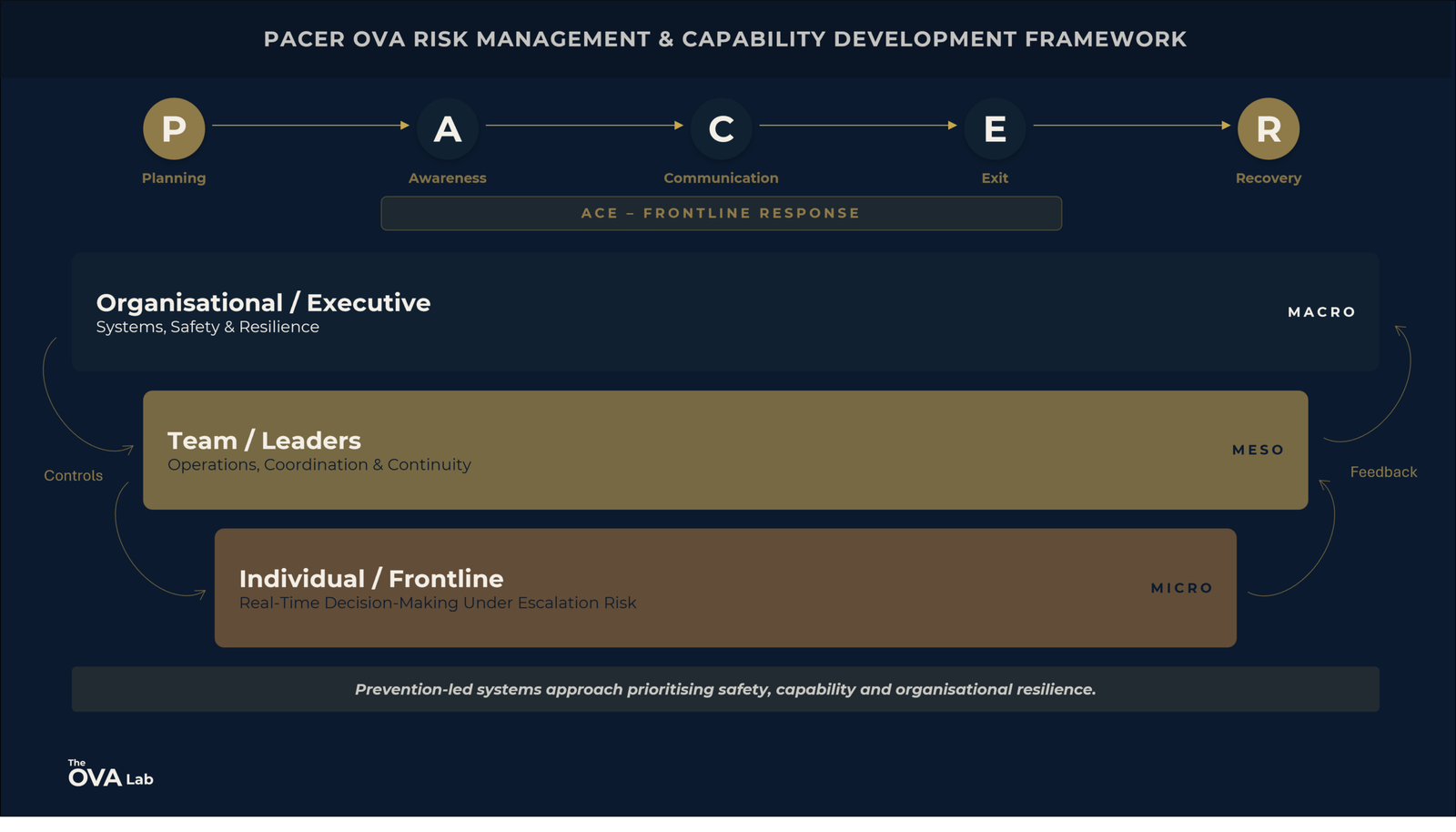
PACER is a prevention-led organisational risk management and capability framework integrating operational response, psychosocial risk management, governance visibility, workforce capability, and organisational resilience.
The PACER Framework was developed to help organisations move beyond reactive incident management and fragmented training approaches toward integrated, prevention-led organisational systems.
Rather than focusing solely on frontline response, PACER strengthens capability across governance, leadership, operations, communication systems, and recovery – recognising that occupational violence risk is shaped by organisational conditions as much as individual interactions. Effective prevention requires capable leaders who can identify emerging behavioural risks, address harmful workplace behaviours early, support conflict resolution, and strengthen psychosocial safety across teams.
Many organisations invest heavily in frontline capability while overlooking the leadership capability required to prevent, recognise, and respond to harmful workplace behaviours. PACER recognises that leaders play a critical role in shaping behavioural expectations, conflict management, psychosocial risk management, organisational resilience, and escalation prevention.
PACER supports capability development at all levels of the organisation, from executive decision-making through to frontline operational practice, helping organisations strengthen how occupational violence risk is prevented, managed, reviewed, and learned from over time.
The framework is operationalised through advisory, systems design, governance improvement, leadership development, operational capability development, and frontline incident response training.
PACER helps organisations strengthen the higher-order organisational controls required to support reasonably practicable risk management, workforce safety, operational resilience, and governance confidence.
Awareness
Self-awareness, emotional intelligence, behavioural awareness, and recognising escalation risk.
Communication
Communication under pressure, workplace conflict resolution, de-escalation, and relationship management.
SYSTEMS-BASED ADVISORY
Beyond training. Building organisational capability and governance confidence.
The OVA Lab helps organisations strengthen occupational violence prevention through systems-based advisory, frontline capability development, psychosocial risk integration, and prevention-led organisational controls.
Rather than relying solely on frontline techniques, we work across governance, leadership, operations, communication systems, and workforce capability to reduce escalation risk and strengthen defensible safety outcomes.
Our training and advisory work supports the broader organisational system — building capability across executives, leaders, operational teams, and frontline staff because occupational violence risk is shaped by organisational conditions as much as individual interactions.
We help organisations strengthen the higher-order controls that influence escalation risk, workforce safety, operational resilience, and executive governance confidence.
Psychosocial Risk Integration
Embedding psychosocial risk management into operational OVA prevention systems, workforce capability, and escalation risk reduction.
Escalation Risk Governance
Strengthening governance visibility, accountability, and defensible systems for managing occupational violence and escalation risk.
Strengthening frontline decision-making, communication, coordination, and escalation management capability under operational pressure.
Systems Architecture
Designing prevention-led frameworks that integrate leadership, operations, psychosocial risk, and organisational resilience.
Workforce Capability
Strengthening frontline and leadership capability, including communication under pressure, conflict resolution, emotional intelligence, reflective practice, resilience and operational decision-making.
Prevention & Learning
Using operational feedback, incidents, and organisational learning to continuously strengthen prevention systems and capability maturity.
SECTOR CAPABILITY
Specialised capability for high-risk public-facing environments.
The OVA Lab works with organisations operating in complex public-facing environments where occupational violence, psychosocial risk, operational pressure, and governance accountability intersect.
We help organisations strengthen prevention capability through integrated operational systems, workforce training and capability, governance visibility, and higher-order organisational controls.
Across all sectors, the risk is the same: inadequate systems leave staff vulnerable and leaders exposed.
Local Government
Customer-facing services, compliance operations, libraries, depots, youth workers, and community interfaces.
Regulators
Inspectors, investigators, compliance officers, enforcement teams, and escalation-prone public interactions.
Healthcare
Hospitals, mental health, emergency care, community health, and complex patient-facing operational environments.
Education
Schools, specialist education settings, leadership teams, and workforce environments managing behavioural escalation, psychosocial pressures, and operational complexity.
Retail & Hospitality
High-volume public-facing environments requiring workforce capability, behavioural escalation management, operational continuity, and customer safety under pressure.
Executive & Governance
Boards, executives, and organisational leaders seeking defensible systems, governance visibility, and operational assurance.
HOW WE HELP
Practical advisory and capability development for complex operational environments.
The OVA Lab helps organisations strengthen occupational violence prevention through integrated advisory, frontline capability development, psychosocial risk management, and prevention-led organisational systems.
Our work combines operational reality with governance insight; helping organisations strengthen workforce capability, reduce escalation risk, and improve defensible safety outcomes across public-facing environments.
We support organisations through training, strategic advisory, governance reviews, operational risk analysis, investigations, and capability development grounded in higher-order organisational controls.
This integrated approach helps organisations strengthen reasonably practicable risk management across governance, operations, leadership, communication systems, and workforce capability.
OVA Training & Capability Development
Frontline capability development supporting communication under pressure, behavioural escalation management, workplace conflict resolution, emotional intelligence, decision-making, leadership, and workforce safety.
Executive and leadership workshops focused on escalation risk, psychosocial hazards, leadership capability, inclusive leadership, governance obligations, organisational resilience, and prevention capability maturity.
WHY ORGANISATIONS ENGAGE THE OVA LAB
Building prevention-led capability, governance confidence, and organisational resilience.
The OVA Lab helps organisations move beyond reactive incident management toward integrated systems that strengthen workforce capability, improve leadership effectiveness, reduce escalation risk, and improve defensible safety outcomes.
Our work combines operational reality with governance insight — supporting leaders to build sustainable prevention capability across people, systems, operations, and organisational culture.
We combine advisory, risk profiling, behavioural risk assessment, leadership development, system design, assurance, and targeted training into a single capability model – not a standalone workshop.
Leaders engage The OVA Lab because they need confidence that their OVA system will stand up to regulatory scrutiny if a serious incident occurs.
Governance Confidence
Strengthening visibility, accountability and defensible systems for managing occupational violence, behavioural risk, psychosocial risk, and escalation pathways.
Prevention-Led Systems
Embedding prevention, capability development, behavioural risk management, and psychosocial risk integration across organisational operations.
Operational Resilience
Strengthening operational readiness, leadership capability, team resilience and organisational response capability during high-pressure and escalation-prone situations.
Strengthening communication under pressure, behavioural awareness, emotional intelligence, conflict resolution, operational decision-making, and escalation management across teams.
Psychosocial Risk Integration
Integrating psychosocial risk management into workplace behaviour, leadership capability, workforce safety, and prevention systems.
Sustainable Capability
Supporting long-term prevention maturity through organisational learning, reflective practice, leadership development, capability improvement, and continuous systems refinement.
WHY THE OVA LAB
A rare combination of operational experience, systems thinking, governance insight, and psychosocial risk expertise.
The OVA Lab was established to address a critical gap in how occupational violence, escalation risk, and harmful workplace behaviours are traditionally understood and managed – the disconnect between frontline capability, psychosocial risk, organisational systems, governance maturity, and operational reality.
Operating at the intersection of operational capability, psychosocial risk management, behavioural risk, organisational systems, and executive governance, The OVA Lab brings together a multidisciplinary perspective rarely found within conventional occupational violence approaches.
We help organisations strengthen workforce and leadership capability while building the higher-order organisational controls, governance visibility, and prevention-led systems required to reduce escalation risk and support defensible safety outcomes over time.
Our work draws on more than 30 years of experience across operational leadership, occupational violence prevention, psychosocial risk, investigations, governance, organisational systems, workforce capability, leadership development, behavioural risk management, and complex public-facing environments.
This integrated perspective enables The OVA Lab to support organisations in building sustainable prevention capability – strengthening workforce capability, leadership effectiveness, organisational learning, operational resilience, and governance confidence across all levels of the organisation.
Operationally Grounded
Experience shaped by frontline operational environments, leadership, escalation management, and complex public-facing systems.
Evidence-Informed
Research-informed practice integrating occupational violence prevention, behavioural risk, psychosocial risk, organisational systems and capability development.
Systems-Focused
A multidisciplinary approach connecting governance, leadership, operations, workforce capability, organisational resilience and prevention-led strategy.
Supporting public-facing organisations across local government, healthcare, education, regulatory, and operational environments since 2007, including experience across 60+ councils and public-facing organisations.