
Occupational violence and aggression (OVA) remains one of the most persistent and complex safety challenges facing organisations today, particularly those delivering frontline regulatory, health, council, and community services.
Too often, organisational responses are reactive: focused on incident reporting, post-event debriefs, and individual resilience. While these matter, they don’t address the systemic conditions that allow risk to escalate in the first place.
That’s why I developed the PACER OVA Risk Management Framework, a prevention-led approach to managing occupational violence risk across every level of an organisation.
The PACER Framework: An Integrated System
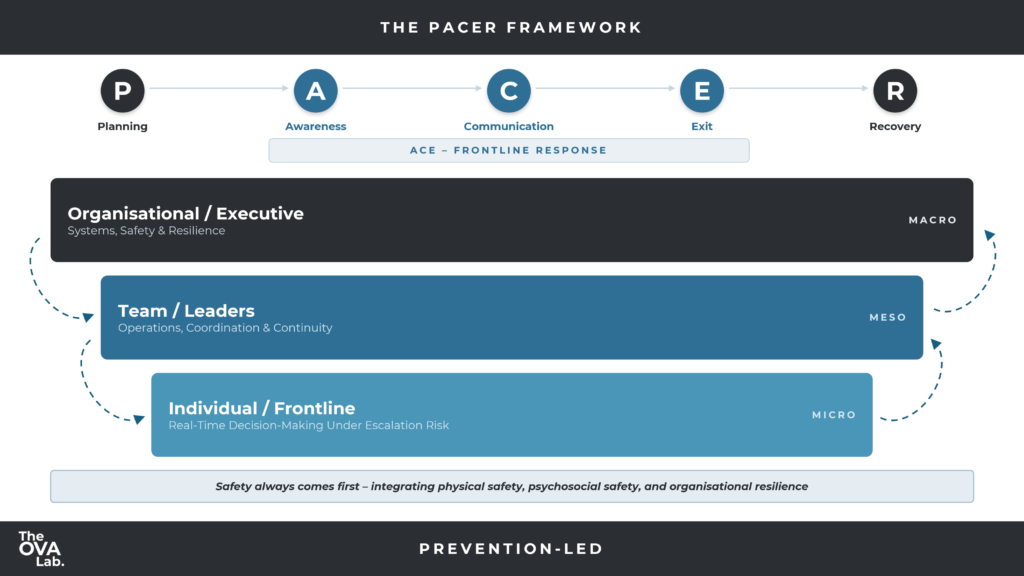
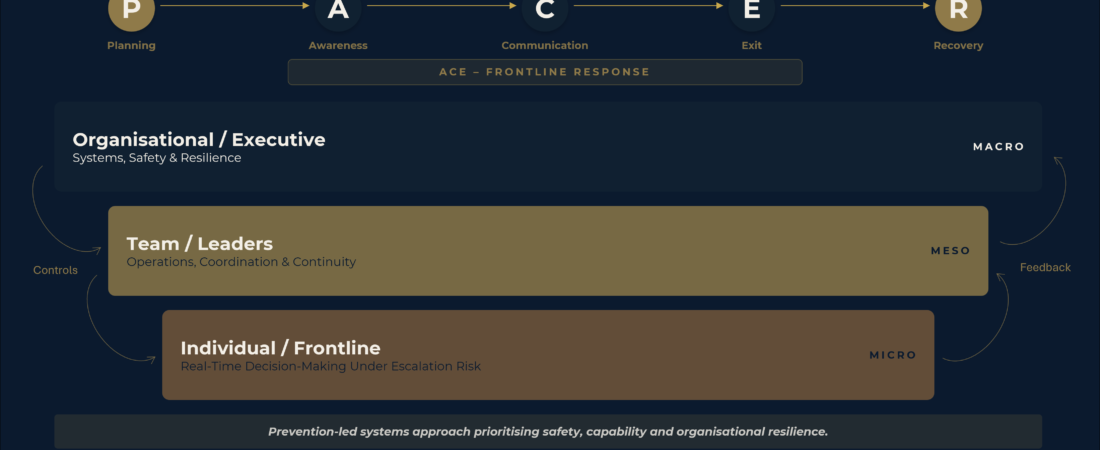
At its core, PACER is a five-stage risk management cycle: Planning, Awareness, Communication, Exit, and Recovery, but the architecture is deliberate. The stages map to three levels of prevention:
- Primary prevention (Planning): Eliminating or reducing risk before it materialises. This is where risk profiling, system design, workforce readiness, and environmental controls do their work.
- Secondary prevention (ACE: Awareness, Communication, and Exit): Managing risk in real time during contact. These three stages form the ACE frontline response: maintaining dynamic situational awareness, using structured de-escalation communication, and knowing when and how to safely disengage.
- Tertiary prevention (Recovery): Learning from events after contact. Debrief, root cause analysis, and feeding lessons back into Planning strengthen the system for next time.
The sequence P → ACE → R isn’t just a mnemonic; it reflects a prevention logic where the goal is to resolve risk as early as possible and learn from every encounter.
A Systems Thinking Approach
PACER applies this cycle vertically through three integrated levels:
- Macro (Organisational/Executive): Systems, safety, and resilience. Executives own the policy architecture, governance, psychosocial hazard management, and organisational resilience that set the conditions for safety.
- Meso (Team/Leaders): Operations, coordination, and continuity. Leaders translate organisational systems into operational practice, managing team safety, task allocation, and service continuity under pressure.
- Micro (Individual/Frontline): Real-time decision-making under escalation risk. Frontline staff apply the ACE response in the moment, drawing on dynamic risk assessment, communication skills, and disengagement strategies.
These levels aren’t siloed. Control / feedback loops integrate the system levels. Controls flow downward: organisational systems shape leadership practice, which equips frontline capability. Feedback flows upward: frontline experience informs leadership decisions, which reshape organisational policy. The system learns and adapts continuously.
Capability Is the Mechanism
PACER is as much a capability development framework as it is a risk management one. Prevention only works if the people at each level are equipped to play their part:
- Executives develop governance, assurance, and strategic oversight capability, the ability to lead safe, resilient organisations.
- Leaders build operational coordination, team safety management, and service continuity skills, the ability to hold the space between organisational intent and frontline reality.
- Frontline staff are equipped with practical, repeatable tools for real-time risk management. The ACE response gives them a structured approach to awareness, communication, and safe disengagement.
This makes PACER a practical tool for HR and Safety leaders looking to implement and embed a prevention-led OVA framework, connecting executive accountability, leadership practice, and frontline capability into a single coherent system.
PACER at the Organisational Level
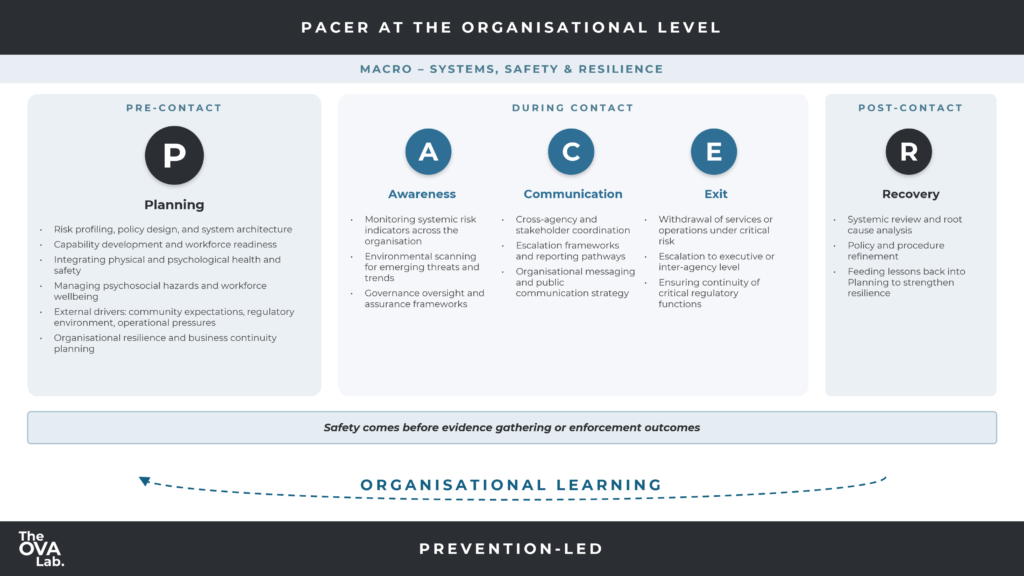
At the Macro level, PACER addresses the systemic architecture that either enables or prevents occupational violence risk. Planning encompasses risk profiling, policy design, capability development, and the integration of physical and psychological health and safety, including managing psychosocial hazards and responding to external drivers like community expectations and regulatory pressures. Awareness focuses on monitoring systemic risk indicators, environmental scanning for emerging threats, and governance oversight. Communication covers cross-agency coordination, escalation frameworks, and organisational messaging strategy. Exit at this level means the withdrawal of services or operations under critical risk and escalation to executive or inter-agency decision-making. Recovery drives systemic review, root cause analysis, and policy refinement, feeding lessons back into Planning to strengthen organisational resilience.
The anchor principle at this level: safety comes before evidence gathering or enforcement outcomes.
PACER at the Team and Leadership Level
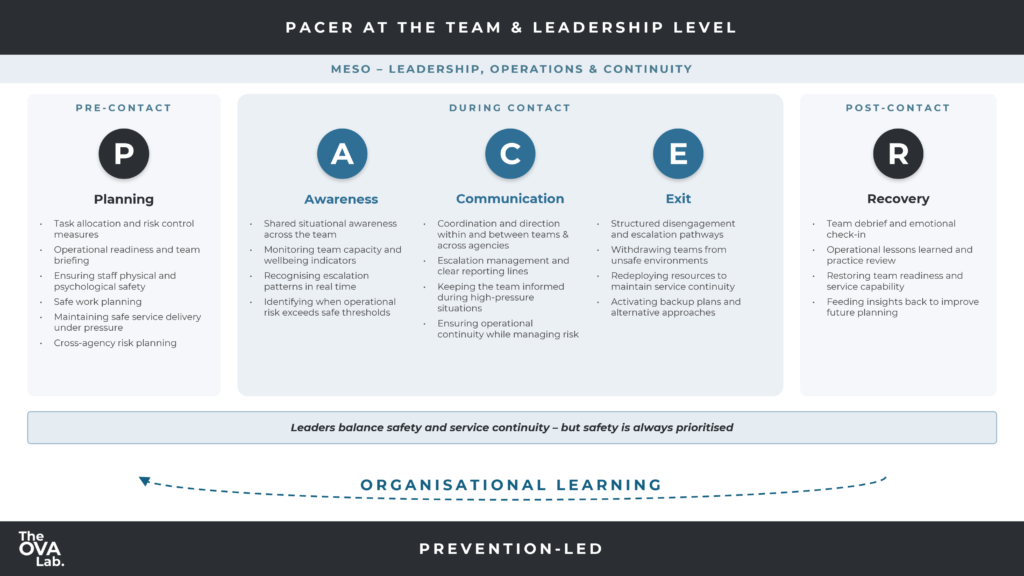
At the Meso level, leaders operationalise the framework. Planning translates into task allocation, risk control measures, team briefings, and safe work planning, ensuring both physical and psychological safety while maintaining service delivery under pressure. Awareness means building shared situational awareness across the team, monitoring capacity and wellbeing indicators, and recognising when operational risk exceeds safe thresholds. Communication is about coordination within and between teams and agencies, clear escalation management, and keeping the team informed during high-pressure situations. Exit involves structured disengagement pathways, withdrawing teams from unsafe environments, and activating backup plans to maintain continuity. Recovery centres on team debriefs, emotional check-ins, operational lessons learned, and restoring team readiness.
The leadership mandate: balance safety and service continuity, but safety is always prioritised.
PACER at the Frontline Level — The ACE Response
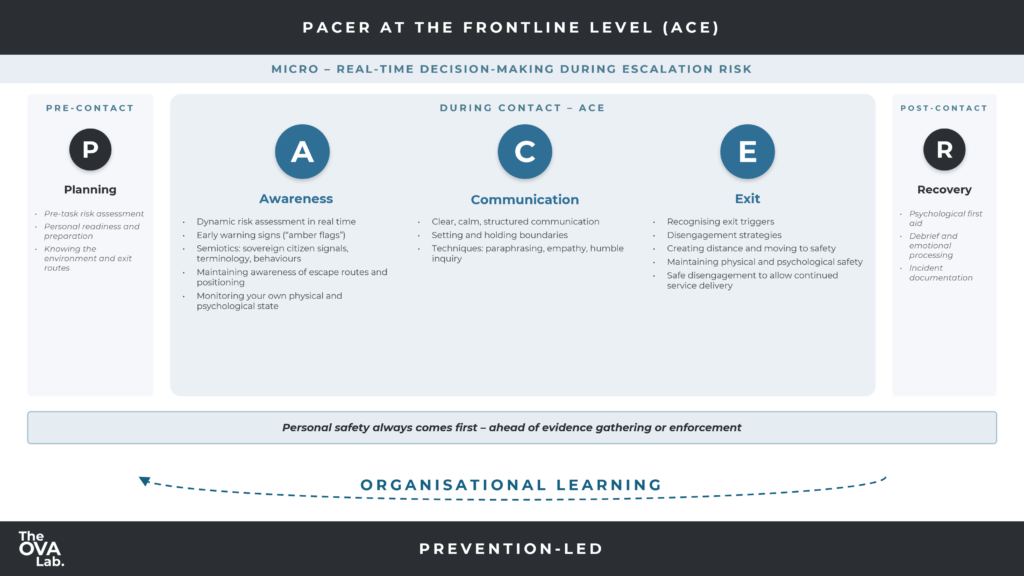
At the Micro level, PACER becomes intensely practical. Planning is pre-task risk assessment, personal readiness, and knowing the environment and exit routes. Awareness is dynamic risk assessment in real time, reading early warning signs, recognising sovereign citizen signals, terminology, and behaviours, maintaining awareness of positioning and escape routes, and monitoring your own physical and psychological state. Communication is clear, calm, and structured, setting and holding boundaries using techniques like paraphrasing, empathy, and humble inquiry. Exit is recognising disengagement triggers, creating distance, and moving to safety, maintaining both physical and psychological safety while enabling continued service delivery. Recovery is psychological first aid, debrief, emotional processing, reflective practice, and incident documentation.
The frontline principle is non-negotiable: personal safety always comes first, ahead of evidence gathering or enforcement.
Bringing It Together
PACER offers a single, integrated framework that connects prevention strategy at the top with real-time decision-making at the frontline. It gives HR and Safety leaders a structured pathway to move beyond reactive incident management toward a genuinely prevention-led approach, one that builds the capability of executives, leaders, and frontline staff as an interconnected system.
If your organisation is grappling with how to embed a systematic approach to occupational violence prevention, I’d welcome the conversation.
More information on the PACER OVA Risk Management & Organisational Capability Development Framework can be found at https://theovalab.com.au/pacer-framework/ or https://theovalab.com.au/ova-training/