
Leadership, Operations, and Service Continuity
Leaders and operational teams play a critical role in preventing and managing occupational violence and aggression risks.
The PACER Framework helps teams operate safely under pressure while maintaining coordination, communication, and operational continuity.
This level of the framework focuses on practical leadership, team awareness, operational readiness, and recovery processes that strengthen both staff safety and service delivery outcomes.
Why Team and Leadership Capability Matters
Frontline staff rarely operate in isolation.
Team dynamics, leadership decisions, operational coordination, and workload pressures all influence workplace violence and aggression risk.
PACER helps leaders and teams:
- Plan work safely
- Monitor operational risks
- Coordinate responses
- Maintain team wellbeing
- Improve learning and resilience over time
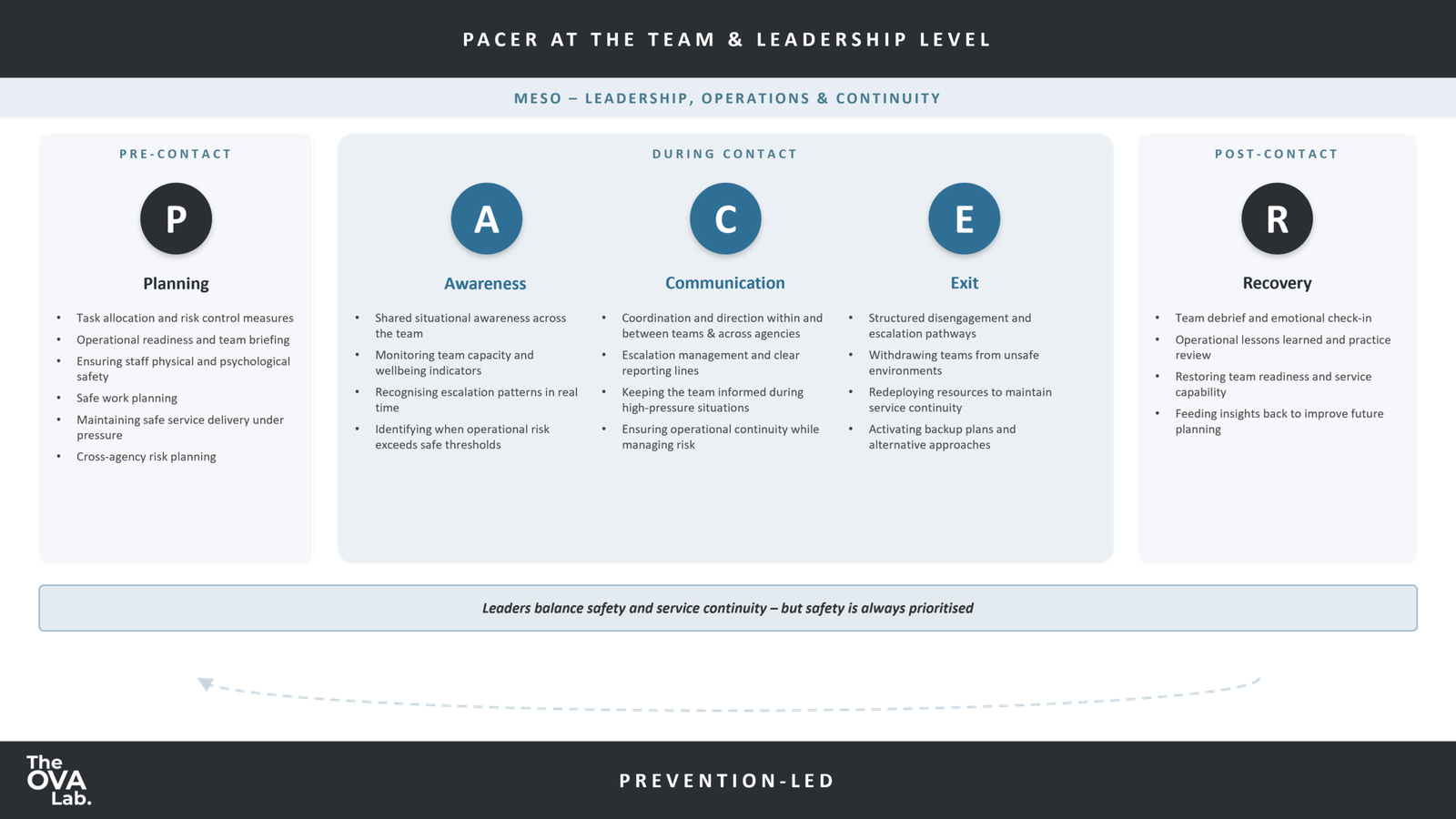
Planning
Operational Readiness and Safe Work Planning
Planning at the team level focuses on preparing staff and operations for safe service delivery.
This may include:
- Task allocation
- Operational briefings
- Risk control measures
- Staffing considerations
- Cross-agency coordination
- Safe work planning
The aim is to create safer operational environments before incidents occur.
Awareness
Shared Situational Awareness
Teams need to maintain awareness not only of external risks, but also internal operational pressures.
This includes:
- Monitoring escalation risks
- Recognising changing behavioural patterns
- Monitoring team fatigue and wellbeing
- Identifying when risks exceed safe thresholds
Shared awareness helps teams respond earlier and more effectively.
Communication
Coordination During High-Pressure Situations
Clear communication is essential during operationally challenging situations.
PACER supports:
- Clear reporting lines
- Escalation management
- Team coordination
- Cross-team communication
- Consistent operational messaging
Strong communication helps teams maintain safety while continuing essential services where possible.
Exit
Structured Disengagement and Escalation
Sometimes the safest option is to withdraw, redeploy, or escalate.
The PACER Framework supports:
- Structured disengagement
- Escalation pathways
- Resource redeployment
- Alternative operational approaches
- Continuity planning
Leaders are encouraged to prioritise safety over operational outcomes when risks become unsafe.
Recovery
Team Learning and Operational Resilience
Recovery helps teams process incidents while strengthening future capability.
This may include:
- Team debriefs
- Emotional check-ins
- Practice reviews
- Lessons learned discussions
- Restoring operational readiness
Recovery activities also support workforce wellbeing and psychological safety.
Supporting Safer Teams and Operations
PACER helps teams and leaders create safer, more resilient operational environments by strengthening:
- Team coordination
- Operational consistency
- Leadership capability
- Workforce wellbeing
- Organisational learning
Enquire About Team and Leadership PACER Training
Contact The OVA Lab to discuss leadership-focused occupational violence and aggression capability development.