
A Prevention-Led Framework for Safer Workplaces
The PACER Framework is The OVA Lab’s prevention-led model for occupational violence and aggression (OVA) risk management.
It provides organisations with a practical and structured approach to preventing, managing, and learning from workplace violence and aggression across all levels of an organisation.
PACER is designed for government, regulatory, compliance, community service, and public-facing environments where staff may encounter aggression, hostility, threats, or escalation risks during the course of their work.
Rather than focusing only on frontline response techniques, PACER supports:
- Organisational resilience
- Team coordination and operational continuity
- Individual worker safety and decision-making
- Continuous organisational learning
- Long-term violence prevention capability
The framework integrates physical safety, psychosocial safety, operational continuity, and organisational learning into a single system-wide approach.
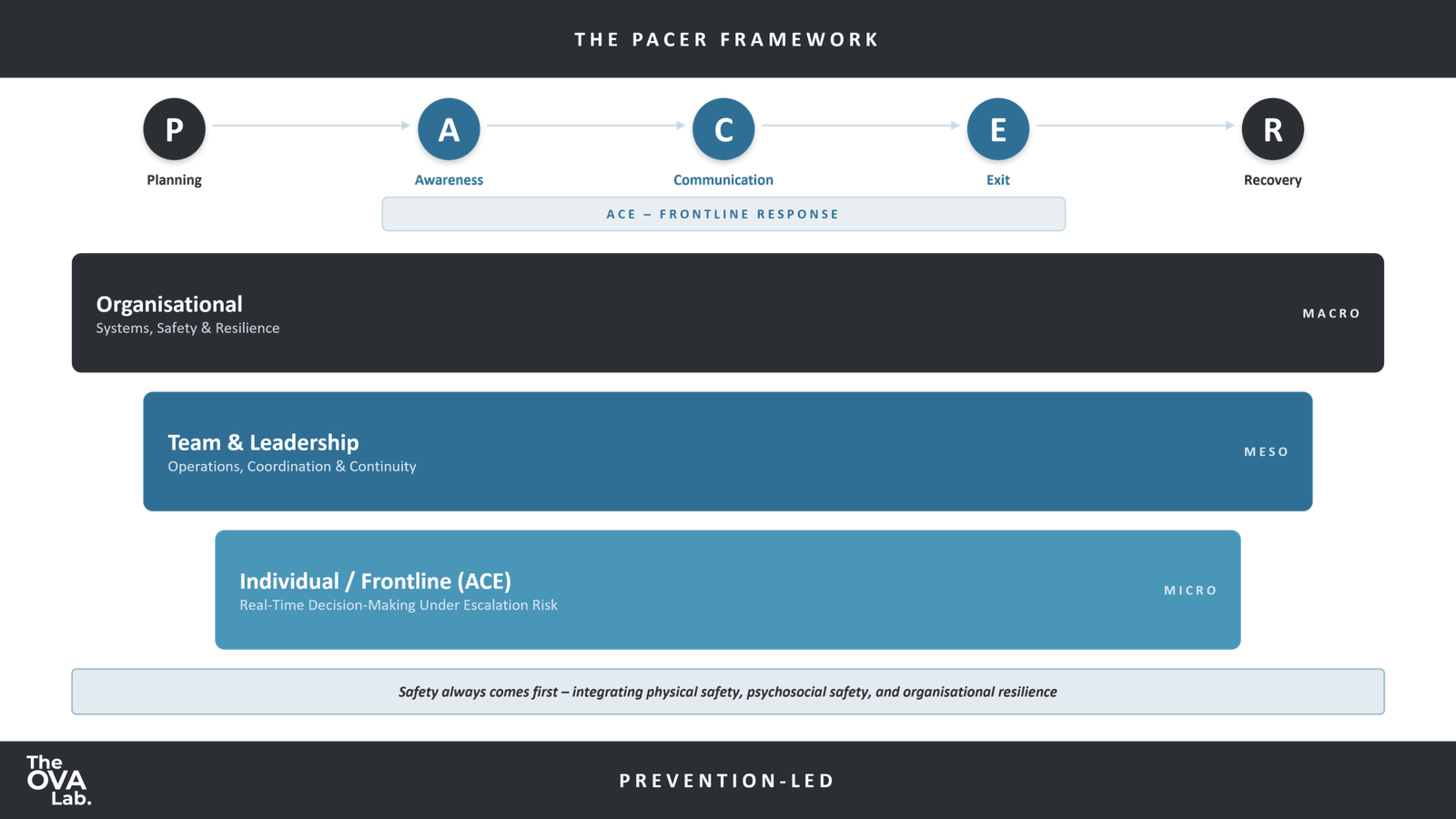
What Does PACER Stand For?
The PACER Framework is prevention-led throughout and built around five interconnected elements:
P – Planning
Preparation before contact occurs
A – Awareness
Recognising risks, behaviours, environments, and escalation indicators
C – Communication
Using structured communication to reduce escalation and support safety
E – Exit
Safely disengaging or escalating when risk exceeds safe thresholds
R – Recovery
Supporting organisational learning, wellbeing, resilience, and continuous improvement after incidents
Together, these elements create a structured approach to occupational violence and aggression prevention and management.
A Multi-Level Framework for OVA Risk Management
PACER operates across three interconnected organisational levels.
Organisational Level
Systems, Safety, and Organisational Resilience
At the organisational level, PACER supports:
- Risk governance
- Workforce capability
- Psychosocial safety
- Business continuity
- System-wide prevention strategies
- Organisational learning
This level focuses on creating systems of work that proactively reduce occupational violence and aggression risks before incidents occur.
[Explore Organisational PACER →]
Team & Leadership Level
Operations, Coordination, and Continuity
At the team level, PACER helps leaders and operational teams:
- Plan work safely
- Coordinate responses
- Maintain operational continuity
- Support staff wellbeing
- Manage escalation risks in real time
This level ensures teams can respond consistently, safely, and effectively under operational pressure.
[Explore Team & Leadership PACER →]
Individual / Frontline Level
Real-Time Decision-Making Under Escalation Risk
At the frontline level, PACER provides practical guidance for workers managing direct interactions with members of the public.
This includes:
- Dynamic risk assessment
- Situational awareness
- Communication and de-escalation
- Safe disengagement
- Recovery after incidents
The focus is always on maintaining physical and psychological safety while supporting safe service delivery.
PACER Is Not a Linear Process
While PACER is often represented visually in stages, it is not a rigid step-by-step model.
In practice, workplace interactions are dynamic and constantly changing.
For example:
- New information may require further planning
- Escalation indicators may increase awareness requirements
- Communication may influence whether exit strategies are needed
- Recovery processes may identify lessons that improve future planning
PACER operates as an ongoing feedback and learning system rather than a simple sequence of actions.
This is one of the reasons the framework supports long-term organisational resilience rather than short-term reactive responses.
Prevention-Led by Design
Many workplace violence and aggression programs focus heavily on incident response after escalation has already occurred.
The PACER Framework takes a different approach.
Prevention is embedded throughout the framework by helping organisations:
- Identify risks early
- Build safer systems of work
- Improve operational planning
- Strengthen communication practices
- Support workforce readiness
- Foster continuous learning
This creates a safer and more sustainable approach to occupational violence and aggression risk management.
Supporting Organisational Learning and Resilience
PACER is designed to strengthen both immediate safety outcomes and long-term organisational capability.
The framework helps organisations:
- Reduce workplace violence and aggression risks
- Improve staff confidence and wellbeing
- Maintain operational continuity
- Support psychologically safe workplaces
- Strengthen organisational resilience
- Build learning cultures over time
Importantly, the framework recognises that safety always comes first, ahead of evidence gathering, enforcement outcomes, or operational pressures.
PACER Training and Capability Development
The PACER Framework is integrated throughout The OVA Lab’s occupational violence and aggression training programs.
This includes:
- Executive capability development
- Leadership and operational programs
- Frontline OVA training
- Team learning and reflective practice
- Longitudinal 70–20–10 learning integration
Training programs can be customised for government agencies, councils, regulatory bodies, community organisations, and other public-facing environments.
Enquire About PACER Training and OVA Risk Management
Contact The OVA Lab to discuss how the PACER Framework can support your organisation’s occupational violence and aggression prevention strategy.