
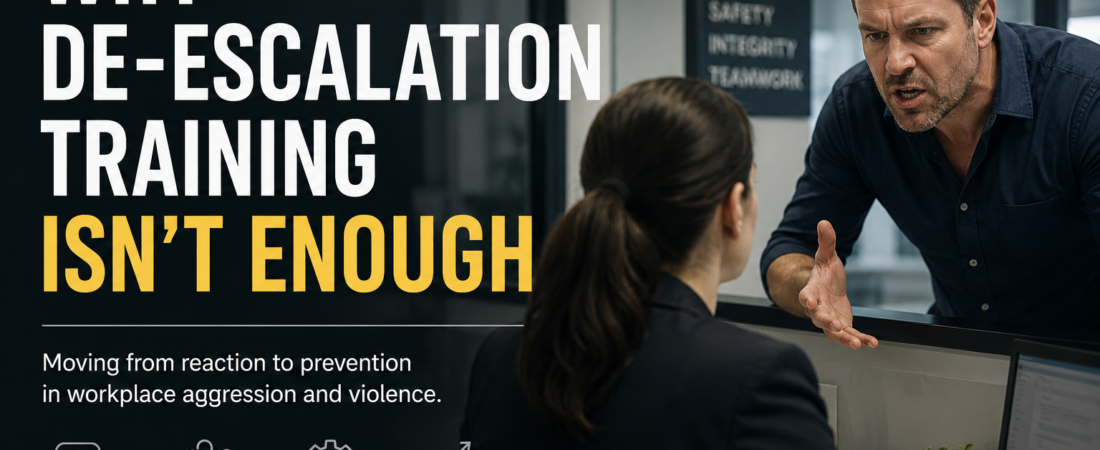
Why De-escalation Training Isn’t Enough
Most conversations about workplace aggression and violence start at the point where escalation has already occurred.
The person is angry.
The interaction is difficult.
Emotions are elevated.
The question becomes:
How do we calm things down?
It’s an important question. But it may not be the most important question.
Perhaps we should also be asking:
How did we get here in the first place?
The Problem with Starting Too Late
When organisations experience aggression, threats, abuse or violence, one of the most common responses is to provide de-escalation training.
There is nothing inherently wrong with that. Communication skills matter. De-escalation skills matter.
But by the time de-escalation is required, a great deal has already happened.
Expectations have been formed.
Frustrations have developed.
Opportunities for prevention may have been missed.
In many cases, the conditions that contributed to escalation existed long before the interaction itself.
That’s why focusing exclusively on de-escalation can be problematic. It risks focusing on one of the final stages of a much larger process.
Aggression Rarely Appears Out of Nowhere
Consider a simple example.
Imagine a customer spends forty minutes on hold trying to resolve a problem.
They’ve been transferred between departments. They’ve listened to repeated messages. Their issue remains unresolved.
Eventually, a frontline worker answers the phone.
At what point did the escalation begin?
Was it when the customer raised their voice?
Or did it begin much earlier?
The reality is that aggression often develops over time. Frustration accumulates. Expectations are unmet. Emotions become elevated.
By the time the interaction occurs, the organisation may have already created many of the conditions that make escalation more likely.
This doesn’t excuse aggressive behaviour. But it does help us understand it.
And understanding how escalation develops is an important part of preventing it.
Communication Is Important, But It Isn’t the Only Control
One of the challenges with traditional approaches is that they often place significant responsibility on frontline workers.
Did the worker use the correct technique?
Did they follow the process?
Did they say the right thing?
These questions may be relevant, but they are not the only questions.
Organisations should also be examining work design, service design, staffing levels, environmental factors, leadership, psychosocial hazards and other conditions that may influence behaviour.
Workplace aggression and violence should be treated as a risk management issue, not simply a communication issue.
Because if the system is creating the conditions for escalation, communication skills alone will never be enough.
Training Is an Event. Capability Is a Process
Another common assumption is that a training course builds capability.
Training is valuable. It introduces concepts, develops awareness and provides a foundation.
But capability develops through practice, experience, reflection, feedback and learning over time.
Think about leadership, investigations, emergency management or sport. Nobody expects mastery from a single training event.
Yet many organisations continue to rely heavily on one-off de-escalation courses as their primary control.
Real capability requires ongoing development at the individual, team and organisational levels.
The course is not the destination.
It’s the starting point.
Recovery Is Where Prevention Begins Again
One of the most overlooked aspects of workplace aggression and violence is what happens after an incident.
Too often, organisations focus on the event itself and then move on.
But every incident contains valuable information.
Every incident provides an opportunity to learn.
What warning signs were present?
What factors contributed?
What controls worked?
What needs to change?
These are not simply compliance questions. They are learning questions.
And organisations that consistently learn from incidents are often better positioned to prevent future harm.
A Broader Conversation
De-escalation remains an important skill.
But if we’re serious about reducing workplace aggression and violence, we need a broader conversation.
A conversation about prevention.
A conversation about systems.
A conversation about capability.
A conversation about learning.
Because aggression and violence rarely appear out of nowhere.
They often emerge from a combination of people, systems, environments and decisions that interact over time.
And if we want to reduce risk, we need to understand the whole system.
Not just the incident.
Watch the full video above for a deeper discussion on why de-escalation training is only one part of a systems-based approach to preventing workplace aggression and violence.