
THE PACER FRAMEWORK
A prevention-led organisational capability framework for occupational violence risk management.
PACER is a systems-based occupational violence prevention and capability framework integrating operational response, psychosocial risk management, governance visibility, workforce capability, and organisational resilience.
The framework was developed by Mark Perret to help organisations move beyond fragmented training and reactive incident management toward prevention-led organisational systems that strengthen workforce safety, operational readiness, and governance confidence.
SYSTEMS-BASED OVA RISK MANAGEMENT & CAPABILITY DEVELOPMENT
PACER is a prevention-led organisational risk management and capability framework integrating operational response, psychosocial risk management, governance visibility, workforce capability, and organisational resilience.
The PACER Framework was developed to help organisations move beyond reactive incident management and fragmented training approaches toward integrated, prevention-led organisational systems.
Rather than focusing solely on frontline response, PACER strengthens capability across governance, leadership, operations, communication systems, and recovery — recognising that occupational violence risk is shaped by organisational conditions as much as individual interactions.
PACER supports capability development at all levels of the organisation, from executive decision-making through to frontline operational practice, helping organisations strengthen how occupational violence risk is prevented, managed, reviewed, and learned from over time.
The framework is operationalised through advisory, systems design, governance improvement, leadership development, operational capability development, and frontline incident response training.
PACER helps organisations strengthen the higher-order organisational controls required to support reasonably practicable risk management, workforce safety, operational resilience, and governance confidence.
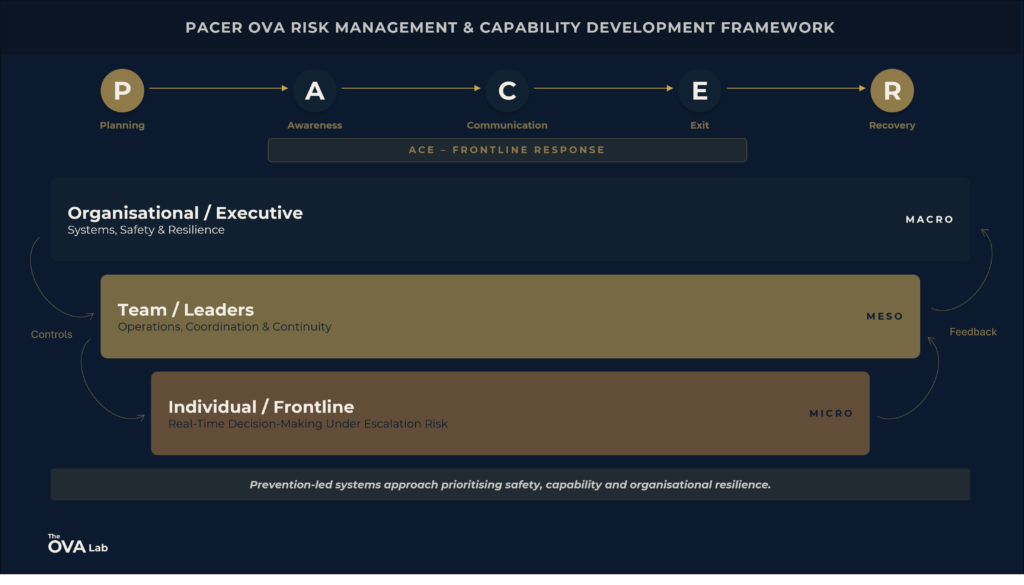
P
Planning
Strengthening governance structures, operational readiness, workforce capability, and prevention-led organisational systems before escalation occurs.
A
Awareness
Maintaining visibility over operational pressures, behavioural escalation risks, psychosocial hazards, and emerging organisational threats.
C
Comunication
Supporting escalation management, operational coordination, leadership communication, and decision-making under pressure.
E
Exit
Managing critical risk through safe disengagement, operational continuity, structured escalation, and protective decision-making.
R
Recovery
Strengthening organisational learning, workforce recovery, governance improvement, and long-term prevention capability.
Organisation-wide OVA Risk Management Capability Development
PACER shifts the focus from reactive incident response toward prevention-led organisational capability.
Governance & Leadership
Strengthening governance visibility, leadership capability, organisational accountability, and prevention oversight.
Operational Capability
Supporting frontline decision-making, communication, escalation management, and operational coordination under pressure.
Psychosocial Risk Integration
Embedding psychosocial risk management into occupational violence prevention systems and workforce capability.
Organisational Learning
Using operational feedback, incident review, and systems learning to strengthen prevention maturity over time.
PACER is operationalised through practical systems thinking tools that support hazard identification, control effectiveness, organisational learning, governance visibility, and defensible occupational violence risk management.
BUILD PREVENTION-LED CAPABILITY
Strengthening organisational capability through integrated operational systems, governance visibility, and prevention-led risk management
The PACER Framework helps organisations move beyond reactive incident management toward integrated occupational violence prevention systems that support workforce safety, operational resilience, organisational learning, and governance confidence.